























Pouring a Durable Concrete Slab for Garages & Outbuildings
Every contractor knows that the long-term integrity of a garage or outbuilding hinges entirely on its concrete slab. A compromised foundation leads to costly repairs, structural issues, and ultimately, damage to your reputation. To lay a slab that endures heavy loads, vehicle traffic, and the unpredictable Midwest climate, mastering precise concrete slab pouring techniques is non-negotiable. This isn't just about mixing and pouring; it's about meticulous planning and execution at every stage.
Site Preparation: Laying the Groundwork for Success
Before any concrete truck arrives, the groundwork must be impeccable. Skimping here guarantees future problems.
Sub-Base & Compaction: The Foundation of Your Foundation
A stable sub-base is critical for uniform support and proper drainage, preventing settling and cracking. Begin by removing all organic material, topsoil, and debris. Excavate to the required depth, typically allowing for a 4-inch minimum slab thickness plus 4 to 6 inches for your compacted granular fill.
For the sub-base, use a well-graded material like crushed stone or gravel (e.g., 3/4-inch clear stone or compactible road gravel). Spread this material in layers no thicker than 4 inches, compacting each layer thoroughly with a vibratory plate compactor. Achieve at least 95% compaction. This prevents future settlement and provides a solid, drainable bed for your slab. Ensure the sub-base is consistently graded and level, with a slight slope away from any future building for proper drainage.
Formwork and Vapor Barrier Installation
Accurate formwork and an effective vapor barrier are essential for a professional, long-lasting slab.
Accurate Formwork: Square, Level, and Secure
Your formwork dictates the final dimensions and elevation of your slab. Use straight, sturdy 2x4s or 2x6s for standard 4-inch or 6-inch slabs, held firmly in place with wooden or metal stakes driven every 2-3 feet. Brace the forms adequately, especially for larger pours, to prevent bowing under the concrete's weight. Ensure all corners are perfectly square using the 3-4-5 rule and that the top edge of your forms is precisely level (or sloped as designed for drainage, typically 1/8 to 1/4 inch per foot away from the building). For quality lumber for your formwork, stakes, and bracing, check with your local R.P. Lumber.
Essential Vapor Barrier Application
Direct contact with moisture from the ground can lead to efflorescence, mold, and issues with flooring adhesives later on. Install a 6-mil polyethylene sheet (vapor barrier) directly over the compacted sub-base, ensuring it's free of tears. Overlap seams by at least 6 inches and seal them with vapor barrier tape. Run the poly sheeting up the inside edge of your forms to the top, trimming excess after the pour. Take care not to puncture the barrier during reinforcement placement.
Reinforcement Strategies for Durability
Reinforcement prevents cracks from widening and adds tensile strength, significantly extending the slab's service life.
Choosing and Placing Reinforcement
For standard garage and outbuilding slabs, welded wire mesh (e.g., 6x6-10/10 gauge) or rebar (e.g., #3 or #4, spaced 18-24 inches on center) are common choices. For heavier loads or larger spans, a combination may be necessary. The key is to suspend the reinforcement in the middle to upper-third of the slab, roughly 2 inches from the bottom. Use concrete chairs or dobies to achieve this precise placement. Never lay reinforcement directly on the sub-base, as it will be ineffective. Cut and overlap reinforcement as needed, tying intersections with tie wire.
Precision Concrete Slab Pouring Techniques
The pour itself requires speed, coordination, and attention to detail.
Concrete Mix Design: Specifying for Performance
For garages and outbuildings, specify a 4000 PSI concrete mix for vehicle traffic, with a proper air entrainment level (typically 5-8% for freeze-thaw resistance in the Midwest). Discuss slump requirements with your concrete supplier; usually a 4-inch slump is manageable for placement without compromising strength. Consider additives like water reducers or set accelerators/retarders based on ambient temperature and project scale. For quality formwork lumber, rebar, and wire mesh, R.P. Lumber has the materials you need for your specified concrete.
Placement, Screeding, and Bull Floating
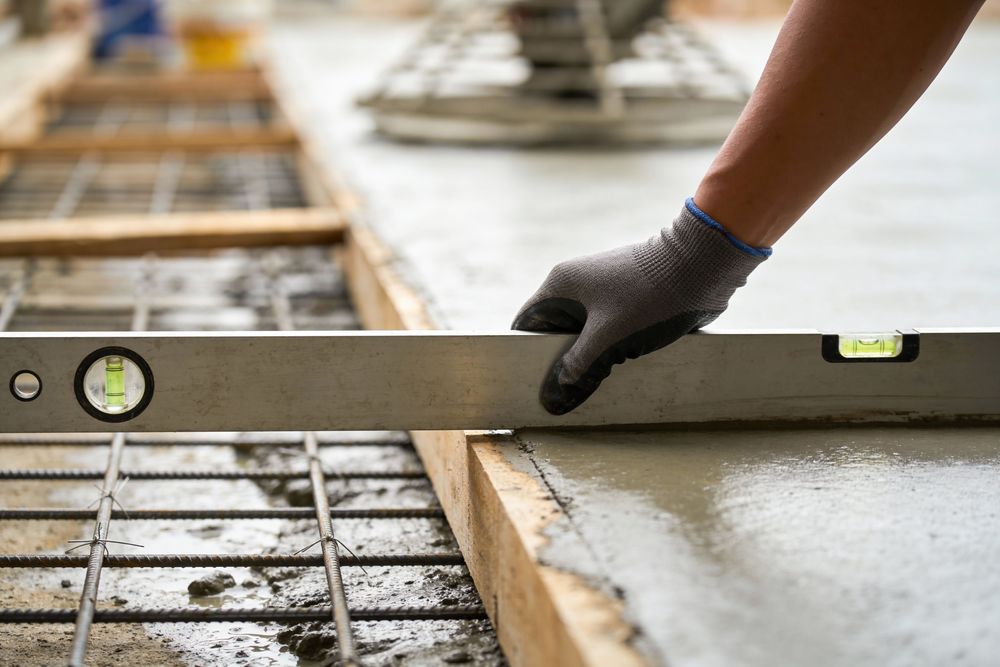
Begin placing concrete at the furthest point from the access. Work steadily, spreading the concrete uniformly across the formwork. Use a straightedge or screed board (a sturdy 2x4 or aluminum screed) to level the concrete to the top of your forms with a sawing motion. Follow immediately with a bull float to push down larger aggregate, bring "fat" (cement paste and fines) to the surface, and remove screed marks. This prepares the surface for subsequent finishing.
Critical Finishing and Curing Practices
Finishing and curing are where the slab's final appearance and ultimate strength are determined.
Mastering the Finish: Edging, Jointing, and Troweling
After bull floating, allow the concrete to set until the surface water has evaporated and it can support a kneeling board without excessive indentation.
- Edging: Use an edger to create a rounded, durable edge along the perimeter, preventing chipping.
- Jointing: Install control joints using a groover (or by saw-cutting later) to a depth of at least 1/4 the slab thickness. For garage slabs, space these joints approximately 10-15 feet apart, forming squares. These joints manage concrete's natural tendency to crack by providing designated weak points.
- Floating & Troweling: Start with a hand float (magnesium or wood) to further smooth the surface. For larger slabs, a power float (walk-behind or ride-on) dramatically speeds up this process. Follow with steel troweling to achieve a hard, dense, and super-smooth finish. Multiple passes with a trowel, spaced out as the concrete hardens, will yield the best results.
The Importance of Proper Concrete Curing
Curing is arguably the most critical step for achieving full design strength and durability. It’s a chemical process where cement hydrates, and requires sufficient moisture and a stable temperature.
- Temperature considerations are critical: aim for pouring when ambient temperatures are consistently above 40°F (and rising) for optimal curing, protecting against freeze-thaw cycles that can compromise strength. If pouring in hotter weather, you might consider a retarder additive or schedule your pour for cooler parts of the day.
- Methods: Immediately after finishing, apply a liquid curing compound with a sprayer, or begin wet curing by covering the slab with plastic sheeting or wet burlap. Maintain this curing regime for a minimum of seven days (ideally 28 days for full strength development). R.P. Lumber carries a range of curing compounds and other concrete accessories to assist with this vital process.
Achieving a high-performance concrete slab demands precision and an understanding of each material and process. By meticulously following these concrete slab pouring techniques, you'll deliver a durable, problem-free foundation that stands the test of time and builds your reputation.
Stop by your nearest R.P. Lumber location to talk with our knowledgeable team about your next concrete slab project. We can help you spec out the precise lumber for your forms, the right gauge reinforcement, and recommend suitable curing compounds to ensure your foundation is built to last.